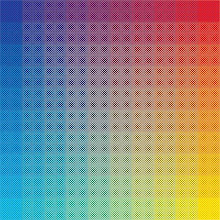
New York, NY—January 10, 2009—Betty Cuningham Gallery is pleased to announce an exhibition of the work of Clytie Alexander. It is Alexander’s first show at the gallery, located at 541 W. 25th Street between 10th and 11th Avenues. The artist will be present for an opening reception on Thursday, February 5 from 6 – 8pm, and the show will remain on view through March 14.
The exhibition will be a comprehensive view of Alexander’s recent work, including approximately sixteen Diaphans and five drawings. Alexander’s Diaphans are painted, rectangular, perforated aluminum sheets which hang 4 inches in front of the wall, seemingly floating or hovering in an aura or reflected light. While spending time in India, she encountered pierced stone screens and her fascination with “permeable boundaries” has continued since then. Her work is not only focused on the surface plane but also on the relationship between the piece and the space around it. [The title “Diaphan”, which Alexander assigns to this series, comes from the Latin word “diaphanous”, meaning “to show through”.
In this exhibition, ten white Diaphans line the main gallery, each measuring 48 x 34 inches. As the light passes through the perforations the subtle changes reveal themselves. In the front gallery, on view are Alexander’s works on paper, juxtaposed alongside color Diaphans. By using translucent paper, Alexander explores similar ideas as she does in the Diaphans; light travels through the glassine, similar to the role of light traveling through the punctured aluminum.


Here
January 11 - March 22, 2009
In Practice Winter '09
Carey Ascenzo, Becket Bowes, Tyler Coburn, Wojciech Gilewicz, Samara Golden, Rachel Mason, Amy Patton, Peter Simensky
Samara Golden, Yes no party, 2009. Foam-core, photographs, lights, mirrors, mixer, closed-circuit video. Dimensions variable
About
Events
Press
Sponsors
The works in this exhibition are commissioned through SculptureCenter's In Practice project series, which supports the creation and presentation of innovative work by emerging artists. The projects are selected individually and reflect the diversity of approaches to contemporary sculpture. The exhibition will be on view January 11 - March 22, 2009.
Carey Ascenzo: Care, 2009
Ascenzo offers a love letter with strings attached in the form of a swap. Allocating her installation budget toward a gift to the organization chosen by the staff, Ascenzo requires in exchange a form of labor that will test the staff's comfort levels. Under the artist's supervision and coordination, SculptureCenter employees and its Executive Director will learn a song to be performed to be performed as part of SculptureCenter's public program "It's All Yours Now", March 15, 2009, at 4:00 pm. Inverting the usual relations of power and support within a museum to produce a collaborative performance, Care addresses the permeable boundary between artwork and non-artwork, and the potent combination of vulnerability and optimism in front of an audience.
Thanks to Paul J. Ascenzo and Ten Minute Turns (tenminuteturns.com)
Very special thanks to Sarina Basta, Mary Ceruti, Adrienne Garbini, Alexandra Lane, and Nickolas Roudané.
Becket Bowes: Social Isolate Club, 2009
Composed of a desk, a library, and a collection of objects, Becket Bowes will be inaugurating a new wing of the Social Isolate Club. The mission of the club is to define the nature of human isolation and decay through the lens of behavioral science, information theory, and a number of irresolute doctrines. The club will present a musical exploration into the meaning of the tragic death of Alan Turing, the great American computer scientist and theorist stigmatized for his sexual orientation in the 1950s; another incarnation of the Ship of Theseus; and some thoughts on logical structures. Throughout the duration of the club's inaugural exhibition, members of the Social Isolate Club can fill out the exhaustive web-based survey on human putrification at www.sicipedia.org.
Tyler Coburn: Medium No. 1 (Manhattan), 2009
Performance, technology, and urban poetics join together in Tyler Coburn's Medium No. 1 (Manhattan). Beginning on the first day of the year, Coburn will transmit improvisatory monologues and conversations recorded on walks across Manhattan to a thermal roll fax machine in SculptureCenter's basement. These daily transmissions will read as a continuous scroll, along a 25-foot long triangular structure, producing an eighty-two day portrait of a city through the interfaces of machine and mind.
Wojciech Gilewicz: In Practice, 2009
A series of oil paintings by Wojciech Gilewicz will be installed outside the SculptureCenter building. The surfaces and forms of the canvases are designed to make them appear completely invisible while they are on site. A documentation of the process of placing the works in their environment will encourage visitors to explore the periphery of the building. Using a map prepared by the artist, visitors are invited to search for the hidden paintings in the surrounding city space. Gilewicz is primarily interested in challenging visitors' perception of space, reality and their surroundings.
Samara Golden: Yes no party, 2009
This installation by Samara Golden is constructed out of found objects, photographs, mirrors, and live video. The piece includes a video camera that broadcasts live images to a monitor at its base. A spectator observing the sculpture is captured by the video camera, and is then able to view an altered version of himself or herself on the monitor. By using combinations of technology and traditional art processes, Golden presents the viewer with multiple ways to see and enter the work. She creates an endless circuit of transmitting and receiving between sculpture, monitor, and viewer.
Rachel Mason: Holy Empire of The Jaw, 2007-2009
Holy Empire of The Jaw is a portrait gallery of important figures in Rachel Mason's life. The portraits are made out of dental molds of the individuals' teeth inset into objects that relate to their life or temperament. The inspiration for the project comes from portraits of the Habsburgs, Holy Roman Emperors in Europe from the XIIV century onwards. The Habsburg Jaw, of particular interest to Mason, is a genetic underbite and enlarged jaw that is a developed trait of this dynasty, and became a celebrated symbol of power as represented in numerous portraits. Mason has taken the Habsburgs as a theme in previous sculptures and performances. In this project, Mason creates her own royal family in the setting of an alternative Holy Empire.
Amy Patton: Hairpin Magic Wand, 2008/2009
In this video by Amy Patton, two actresses are seen performing a single monologue written in response to an ambiguously labeled ancient Egyptian artifact on display at The Metropolitan Museum of Art. Mysterious voices chime in, and, through the privileges of prosopopeia, allow the hairpin/magic-wand to speak. Drawing on the conception of an echo chamber, Patton's work explores nonlinearity of time, and conceptual leaps that can lead to the dematerialization of the art object. Produced and performed in the lower level gallery space at SculptureCenter, the work was developed as part of a year-long collaboration with curator Christina Linden. Additional elements of the project will be presented in an exhibition opening April 19 at the Center for Curatorial Studies at Bard College.
Peter Simensky: CONSULTING MEDIUMS. Finding meaning(s) in uncertain times., 2009
Peter Simensky's installation places divination rods within the lower level gallery space. The forms of these rods are based on the artist's research into the use of divining mediums. Simensky will use this knowledge to trace the space of SculptureCenter's basement, searching for objects of value hidden below the floor. Simensky's piece explores how artistic gestures create potential value, and how these sets of relations might find a form of translation within objects that combine the functional, the decorative, and the symbolic.


Art Radio International renegotiated the terms of its lease of the Clocktower Gallery with MoMA recently, consequently terminating their sublease with The Film-Maker’s Co-op (FMC) . Founded nearly 50 years ago, FMC is one of the longest-running distributors of experimental and independent film in the world, its offices operating in the same building since 2000. The organization houses thousands of 16mm prints, many of them unique and irreplaceable including those by Stan Brakhage, Paul Sharits, Carolee Schneeman, Tony Conrad, Hollis Frampton, Jennifer Reeves, Jack Smith, Ken Jacobs, Peggy Ahwesh, Joyce Wieland, Michael Snow, Maya Deren, Marie Menken, Jonas Mekas, Shirley Clarke, Martha Colburn, Leslie Thornton, and literally hundreds of other artists, as well as an invaluable paper archive of letters, program notes and other materials. According to sources moving these fragile prints will take thousands of dollars the Co-op simply can’t afford.
Now, losing a lease is never good news, but it certainly can’t help that Art Radio International went from having included the organization in the floor plans of the lease negotiations with MoMA to deciding there was no longer space for the organization and demanding they vacate their offices within a few days of having been notified. Sources tell me they have responded to none of FMC’s emails, a move likely to dissolve a 9 year working relationship.
Meanwhile, the Co-Op has sent out a newsletter to members alerting them to the situation. FMC is appealing to the Department of Cultural Affairs Commissioner Kate D. Levin for support either in the form of remaining in the current building either or to moving to another, affordable city space.
The Co-op represents over 700 independent filmmakers, and is an invaluable resource the filmmaking community can not afford to lose. To express your support for Independent film and write to Kate D. Levin directly at http://www.nyc.gov/html/mail/html/maildcla.html. The FMC Urgent Update email begins after the jump.
January 30–April 19, 2009
This exhibition traces how Asian art, literature, and philosophy were transmitted and transformed within American cultural and intellectual currents, influencing the articulation of new visual and conceptual languages. It explores how American art evolved through a process of appropriation and integration of Asian sources that developed from the 1860s through the 1980s, when globalization came to eclipse earlier, more deliberate modes of cultural transmission and reception. While Europe has long been recognized as the font of mainstream American art movements, the exhibition explores an alternative lineage of creative culture that is aligned with America's Pacific vista—Asia.
Vanguard artists consistently looked toward "the East" to forge an independent artistic identity that would define the modern age—and the modern mind—through a new understanding of existence, nature, and consciousness. They drew ideas from Eastern religions, primarily Hinduism, Buddhism, and Taoism, as well as classical Asian art forms and performance traditions. Opening with the late nineteenth-century Aesthetic movement and the ideas promulgated in transcendentalist circles, The Third Mind illuminates the Asian influences shaping such major movements as abstract art, Conceptual art, Minimalism, and the neo-avant-garde as they unfolded in New York and on the West Coast. It also presents select developments in modern poetry, music, and dance theater.
The Third Mind refers to a "cut-ups" work by Beat writers William S. Burroughs and Brion Gysin, whose cult of spontaneity in art and life drew inspiration from Asian attitudes. This manuscript composed of random texts and images evokes the eclectic yet purposeful method by which American artists often appropriated material from Asia to create new forms, structures, and meanings in their work. Misreadings, mediations, denials, and imaginary projections emerge as important iterations of this creative process. Some artists identified with non-Western art and thought precisely to subvert and critique what they saw as the spiritually bankrupt capitalist West. Others culled alternative, East-West identities from transcendentalism, Theosophy, Carl Jung's formulations of the collective unconscious, and New Age movements preaching the perennial vitality of Asia's spiritual psychology in a global age. Still others simply extracted and freely enlisted what served their particular artistic impulses. Grounded in documentary evidence of the artists' encounters with Asia, this exhibition shows how artists working in America adapted Eastern ideas and art forms to create not only new styles of art, but more importantly, a new theoretical definition of the contemplative experience and self-transformative role of art itself.
Here is the Guggenheim website.